Completion requirements
4. The Theory of Change - 2
The ToC for a project can be as simple as “if we conduct activity A to produce output B in setting C, the result will be outcome D, which will ultimately contribute to objective E.” For example, a simplified version of the ToC for a project with the objective to reduce gender-based violence through increasing accessibility of police services for women and girls might be: “If we provide funding, training and technical assistance to the national police in three rural districts (activities) to establish specialized gender desks in twelve police stations (outputs), we will increase the ability of women and girls to safely access justice in the areas served by these stations (outcome) and ultimately contribute to a reduction in gender-based violence (objective).”
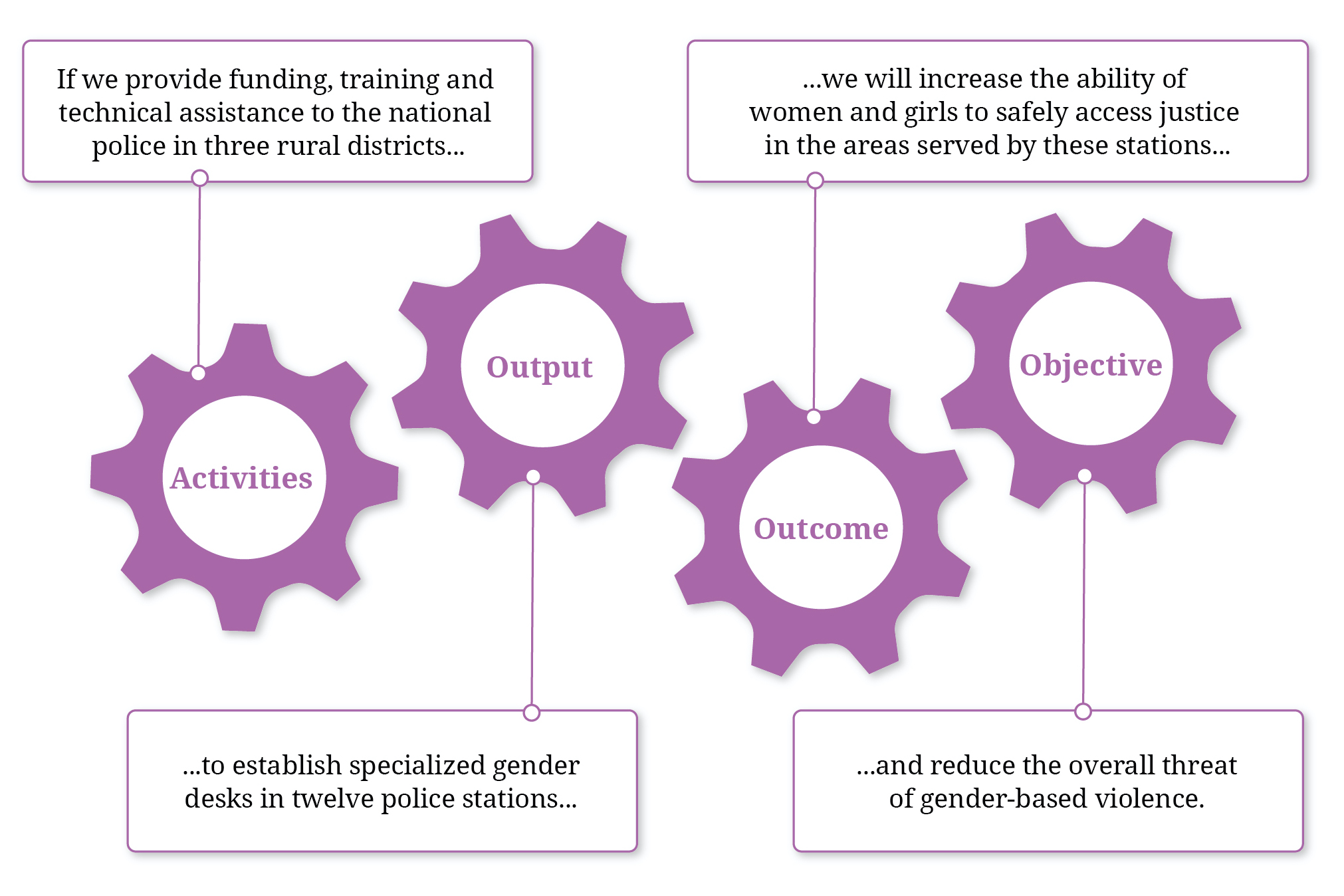
In the field of SSG/R, as well as other fields, one challenge is the identification and description of assumptions about which activities will lead to positive short-, mid- and long-term change. However, as such assumptions are rarely tested during the planning phase and the situation in the course of implementation can change, certain activities and short-term results may not lead to the intended mid- and long-term changes. To mitigate this risk, OSCE staff can develop a ToC to identify the sequence of results at different levels and the assumptions underpinning each causal link. The continuing validity of the assumptions established at the planning phase and risks identified for the ToC should be regularly updated while implementing the programme and adjust the implementation.
Projects may operate on more than one ToC. One theory might address the approach taken (methodology), while another addresses the choice of project participants or the timing of activities. Multiple ToCs can also be combined into a single statement: “If we work with groups A, B and C and apply approach/methodology D at time E, we will achieve results F, G and H.”
Developing a ToC consists of three main steps: (1) Identifying the expected or desired change/changes, (2) articulating how the changes will be made as a result of programming efforts, and (3) developing one or more “If X then Y because...” statements.