Results-Oriented Programming in the Field of SSG/R

Site: OSCE eLearning
Course: OSCE Training on Security Sector Governance and Reform (SSG/R)
Book: Results-Oriented Programming in the Field of SSG/R
Printed by: Guest user
Date: Thursday, 1 October 2026, 1:25 AM

1. Introduction


Welcome to the fifth module of the OSCE Training on Security Sector Governance and Reform (SSG/R). After completing both e-learning and in-class parts of this module, you should be able to:

      • Describe the results-based management framework and its different components in the OSCE context
      • Develop long-, mid- and short-term results, indicators and means of verification for OSCE’s SSG/R-related programmes and projects
      • Develop a theory of change in the field of SSG/R
      • Discuss approaches to programming, monitoring and evaluation for results-oriented OSCE support to SSG/R

The module is based on the fifth chapter of the Guidelines on SSG/R for OSCE Staff (2nd edition), which is required reading for this course.

2. The Results-Based Management Framework in the OSCE Context

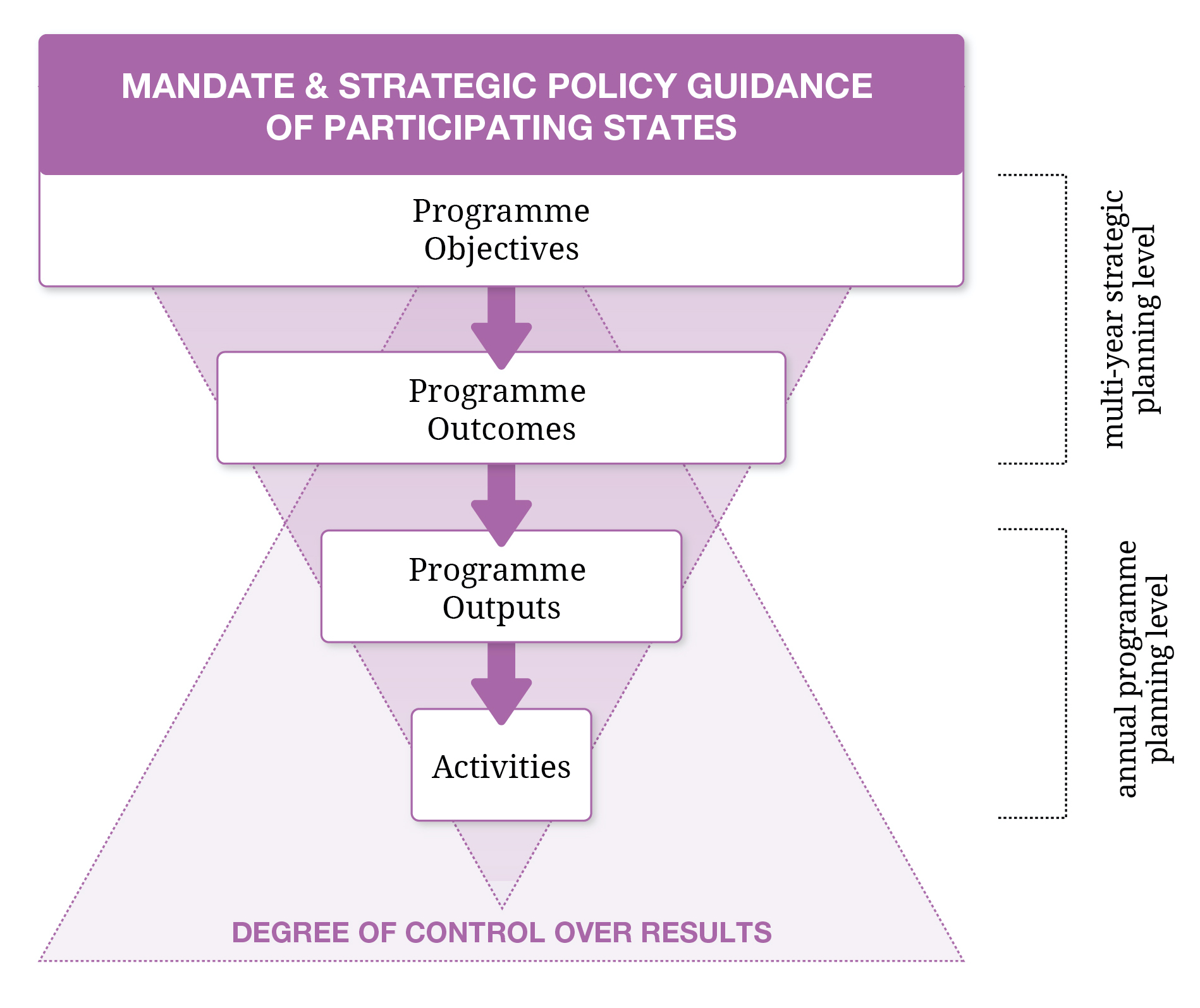
The OSCE’s approach to results-based management (RBM), known as Performance-Based Programme Budgeting (PBPB), is the OSCE’s Unified Budget (UB) management tool. It defines the intended objectives (long-term results), outcomes (mid-term results), and outputs (short-term or annual results) at the programme level while ensuring that there is a cause-and-effect relationship between the key elements. PBPB promotes the development of a coherent theory of change, which identifies the results the OSCE seeks to contribute to across the results chain at the programme and project levels. It foresees that all actors will contribute directly or indirectly to achieving a set of results and ensures that their processes, products and services (as outputs) will contribute to the achievement of the desired mid- to long-term outcome and objective.

Click on each tab to read more.

An objective is at the highest level of the results chain. It is the intended end result, which the programme aims to support the beneficiary/host country in achieving over several years in line with the mandate and OSCE commitments. As such, objectives should reflect results that contribute to a “change in condition for the beneficiaries and their wider environment.” These results are outside the OSCE’s control, as the OSCE can only seek to contribute to the achievement of objectives, alongside other national and international actors who also contribute to the same nationally owned long-term results. For that reason, the OSCE formulates objectives at the programme level in terms, such as to advise, to assist or to support host country authorities. While the OSCE does not have full control over the achievement of the objective, it does have some level of influence.

Outcome is a mid-term result generated by outputs. Although the achievement of outcomes may be affected by outside factors and not within the direct control of the OSCE, they should be within the reasonable influence of the OSCE. Outcomes often reflect behavioural or institutional change. The level at which to place an outcome is contextual and depends on the cause-and-effect relationship of the different programme elements (i.e., the activity, output, outcome, and objective). The same programmatic result may be thus an outcome in one context but an output in another context.

Outputs are specific products or services resulting from one or several OSCE activities. They are direct results of a combination of these activities, leading to immediate changes in knowledge, skills, awareness or processes.

Activities are not results in themselves. Activities are required to transform inputs (time, resources) into outputs (i.e., products and services).

For additional explanations as well as specific examples, see section 2.1 of Chapter 5 in the Guidelines.
3. The Theory of Change - 1

A theory of change (ToC) is a statement that explains why we think certain actions will produce outputs leading to the desired change in a given context. It outlines all the cause-and-effect relationships between the elements in the result chain and provides the narrative that explains the logic of the intervention applied.

A ToC takes the logframe matrix one step further in that it offers a representation of the results chain, accompanied by a narrative to map and explain the various connections between each level of results. It acknowledges the non-linear nature of a results chain and the fact that there may be multiple strands that lead to a single result. As such, a ToC is particularly useful in maintaining the focus on long-term results and the changes required to achieve them. Moreover, it can help in understanding the complexity of SSG/R interventions, where multiple projects may be required to contribute to a single programme objective. A ToC is also particularly useful in identifying ways that activities in different OSCE dimensions can contribute to a common overarching objective. Description of theories of changes should be as comprehensive as possible and gender-sensitive.

To develop a ToC, OSCE staff should plan towards the intended objective and identify the kind of change needed for it to be realized. They should then plan for OSCE support by moving backwards along the results chain, determining the changes that need to be made for each result level to be attained. They should also reflect on the underlying assumptions of the theory of change; for each result, they should ask what assumptions need to be fulfilled for the next result to be achieved.

4. The Theory of Change - 2

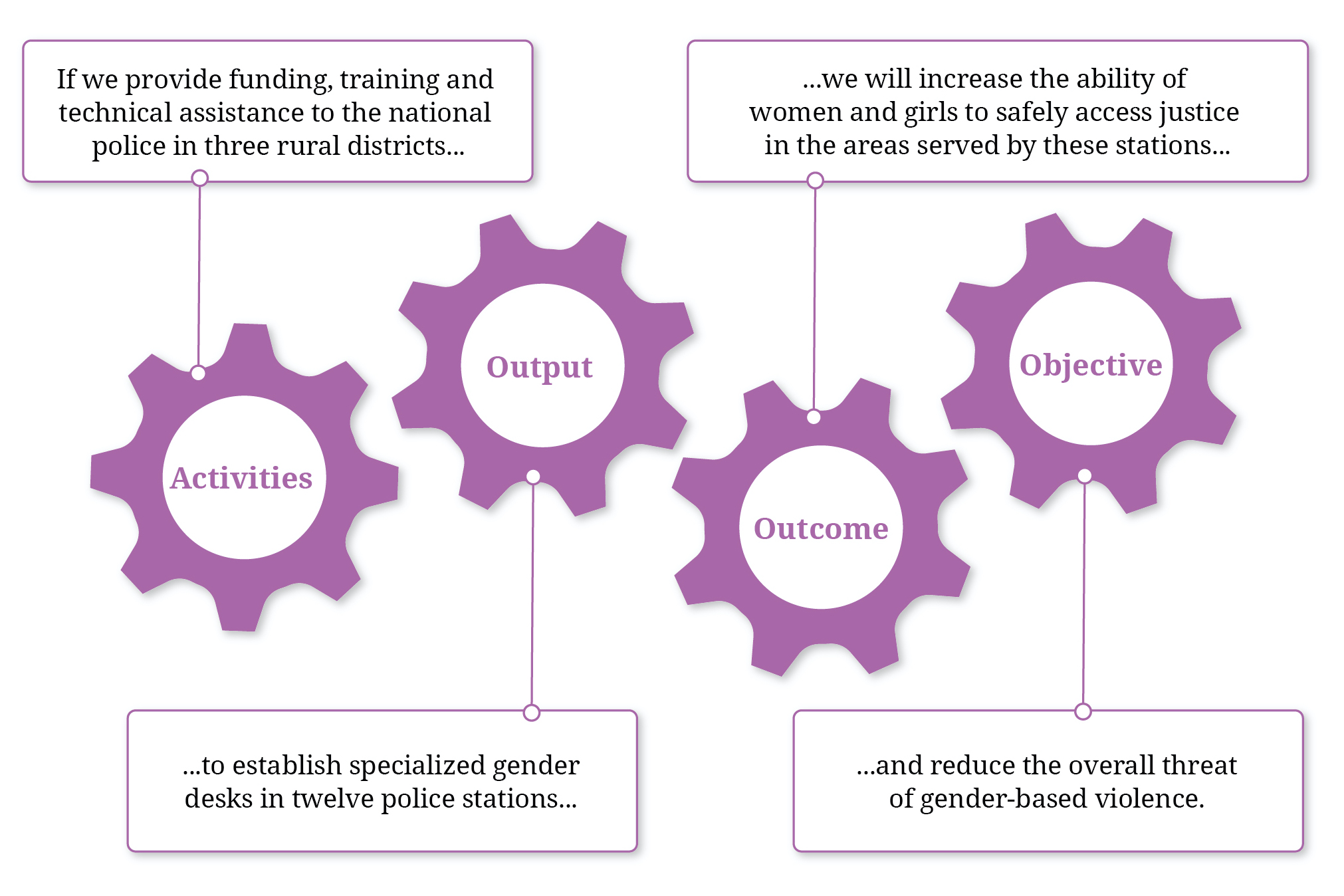
The ToC for a project can be as simple as “if we conduct activity A to produce output B in setting C, the result will be outcome D, which will ultimately contribute to objective E.” For example, a simplified version of the ToC for a project with the objective to reduce gender-based violence through increasing accessibility of police services for women and girls might be: “If we provide funding, training and technical assistance to the national police in three rural districts (activities) to establish specialized gender desks in twelve police stations (outputs), we will increase the ability of women and girls to safely access justice in the areas served by these stations (outcome) and ultimately contribute to a reduction in gender-based violence (objective).”

In the field of SSG/R, as well as other fields, one challenge is the identification and description of assumptions about which activities will lead to positive short-, mid- and long-term change. However, as such assumptions are rarely tested during the planning phase and the situation in the course of implementation can change, certain activities and short-term results may not lead to the intended mid- and long-term changes. To mitigate this risk, OSCE staff can develop a ToC to identify the sequence of results at different levels and the assumptions underpinning each causal link. The continuing validity of the assumptions established at the planning phase and risks identified for the ToC should be regularly updated while implementing the programme and adjust the implementation.

Projects may operate on more than one ToC. One theory might address the approach taken (methodology), while another addresses the choice of project participants or the timing of activities. Multiple ToCs can also be combined into a single statement: “If we work with groups A, B and C and apply approach/methodology D at time E, we will achieve results F, G and H.”

Developing a ToC consists of three main steps: (1) Identifying the expected or desired change/changes, (2) articulating how the changes will be made as a result of programming efforts, and (3) developing one or more “If X then Y because...” statements.

5. Monitoring and Evaluation Framework

An M&E framework builds on two key elements: the indicators, and the respective baseline and target. For M&E purposes, means of verification are also important.

Indicators
Indicators are quantitative or qualitative references that provide a simple and reliable means to measure progress and achievements. Indicators should be SMART (i.e., specific, measurable, available, realistic and time-specific) and be set for all levels of the logframe or results chain. Where applicable, indicators should be disaggregated by sex and other intersecting factors such as age. The aim of the indicators is to demonstrate that the project has completed its activities, delivered its intended outputs and outcomes and achieved its objective.
Baseline
The baseline provides a snapshot of the situation before the project is implemented and can be defined during a needs assessment. Baseline information is necessary not only to justify the relevance of a project but also to measure progress against the indicators and towards the set target.
Target
Targets may come from national strategies, policy documents, or negotiations with stakeholders. By the same token, monitoring is not just to measure progress against targets but to discover whether remedial actions need to be implemented when progress is behind schedule.
Means of Verification
They include what data is collected to measure progress on each indicator and against the baseline, as well as how and when the data is collected. Identifying appropriate means of verification and collecting necessary data can often be challenging, particularly in the field of SSG/R, because SSG/R interventions are often qualitative rather than quantitative or because data is not publicly available. Moreover, some key data may not be accessible because they are considered too sensitive to share.

For further information see section 2.3 in chapter 5 of the guidelines.

6. Programming and Monitoring for Results-Oriented Support

A number of elements need to be taken into account to successfully provide results-oriented support.

Click on each headline to read more.

An important tool to map national priorities in the field of SSG/R is the needs assessment process. Without a comprehensive needs assessment, it is impossible to understand and target the needs of the security sector and to ensure a sustainable long-term approach to SSG/R assistance. For further information, see section 3.1 in Chapter 5 of the Guidelines.

In line with the mandates of executive structures and national priorities, OSCE interventions should be designed in a way that they achieve different levels of results, which ultimately contribute to long-term sustainable change. The results chain of the intervention should be developed in accordance with the theory of change established by the executive structure and, when relevant, any theories of change defined for the UB programme. For further information, see section 3.2 in Chapter 5 of the Guidelines.

OSCE uses the PBPB approach to plan, develop and manage its UB Programmes. UB Proposal organizes the work of OSCE Executive Structures into a number of UB Programmes that describe achieving short-term results (outputs), contributing to mid-term (outcomes) and long-term results (objectives). UB and EXB projects contribute to the achievement of the objectives of a UB Programme and, ultimately, to the political commitments of the Organization. For further information, see section 3.3 in Chapter 5 of the Guidelines.

Ideally, all international actors engaged in SSG/R work in a country should work in concert towards achieving the same mid- to long-term results, in line with national priorities. For further information, see section 3.4 in Chapter 5 of the Guidelines.

OSCE support will be more comprehensive and results-oriented when OSCE actors collaborate across all three dimensions of security. Cross-dimensional collaboration facilitates a move away from fragmented support (which may have limited results) towards the achievement of long-term results, which can be coherently supported from different dimensional perspectives. All OSCE Executive Structures should ensure that strategic objectives are identified in all three dimensions of security in order to provide support that achieves the greatest impact. Cross-dimensional needs assessments are useful tools to ensure that needs can be identified and addressed in all three OSCE dimensions.For further information, see section 3.5 in Chapter 5 of the Guidelines.

Change is closely related to sustainability; if reform efforts are not sustained over a time, the results achieved will be lost and little change will be made. Sustainability can only be ensured if national actors have the willingness and capacity to keep up reform efforts. For further information, see section 3.6 in Chapter 5 of the Guidelines.

While the OSCE should strive to ensure its support has a long-term impact and is sustainable, it may at times be necessary to invest in quick-impact initiatives that build confidence or prepare the ground for longer-term engagement. Such engagements are generally small scale, of immediate benefit to the population or key stakeholders and meet a targeted need. For further information, see section 3.7 in Chapter 5 of the Guidelines.

Effective M&E is essential to ensure that progress is regularly recorded and on track, risks are assessed and mitigated, the project is adjusted if needed and its contribution to achieving long-term results can be evaluated. To ensure that M&E supports the OSCE’s contribution to long-term results, it must go beyond the level of outputs and focus on outcomes. For further guidance for planning M&E and mitigating some key challenges, see section 3.8 in Chapter 5 of the Guidelines.

In supporting results-oriented approaches to SSG/R, potential challenges include: lack of political support for impact-oriented reforms, balancing national ownership with results-oriented approaches, dealing with context-specific change, dealing with unforeseen challenges, capacity of the beneficiary to deliver reforms. For further guidance for addressing these challenges, see section 3.9 in Chapter 5 of the Guidelines.

7. Results-Oriented Approaches in Different Types of Support

This section offers concrete suggestions and food for thought on how to implement results-oriented approaches to SSG/R support in the areas most commonly addressed in OSCE programming. Programmatic activities should thus be conducted in ways that maximize the potential to achieve long-term and sustainable results. Results can be best achieved when all types of support are connected to the overarching programme objective and when due consideration is given to enhancing the sustainability of results.

Click on each headline to read more.

The OSCE often develops and publishes knowledge products, such as guidelines and handbooks, which may be used to raise awareness or to support national actors in implementing reform efforts. The OSCE also supports the conduct of targeted mapping exercises and the development of assessments and monitoring reports for specific countries, when requested. For further guidance for increasing the impact of knowledge products, see section 4.1 in Chapter 5 of the Guidelines.

The OSCE often supports workshops, seminars, conferences and study visits to raise awareness of OSCE commitments, as well as other international norms and good practices relevant to the security sector. For further guidance for increasing the impact of promoting norms and good practices, see section 4.2 in Chapter 5 of the Guidelines.

The OSCE may be requested to review the law-making process in a participating State, to comment on a particular law related to the security sector or to support the subsequent implementation of laws. The OSCE’s recommendations assist participating States in ensuring their laws comply with OSCE commitments and other international standards. Such recommendations are often provided by OSCE field operations or by ODIHR, often jointly with the Council of Europe’s European Commission for Democracy through Law (Venice Commission). For further guidance for increasing the impact of advice for legislative reform processes, see section 4.3 in Chapter 5 of the Guidelines.

Providing policy advice to a participating State is an effective way to support its reform efforts. Policy advice can take many forms, including advice on the possible options for reform, on the review of national plans or on strategy development. For further guidance for increasing the impact of policy advice, see section 4.4 in Chapter 5 of the Guidelines.

Strengthening national capacities is crucial in supporting long-term and sustainable reform led by national actors. Capacity-building may include the development of individual skills – for example, through training – or support to broader institution building, such as the establishment of structures and processes. For further guidance for increasing the impact of capacity-building, see section 4.5 in Chapter 5 of the Guidelines.

8. Wrap-up Questions

Get to the questions