Kërkesat e përfundimit
2. The Results-Based Management Framework in the OSCE Context
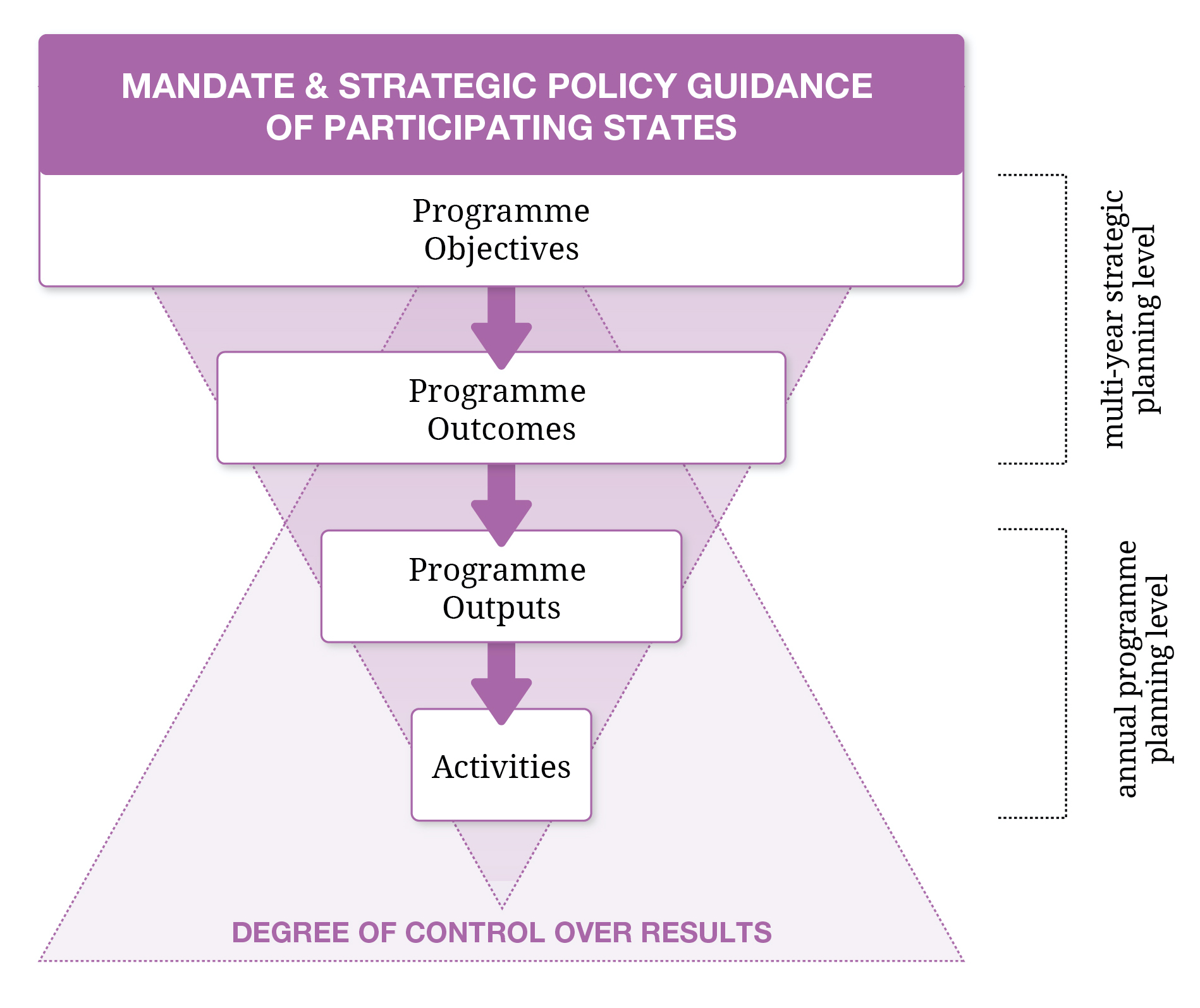
The OSCE’s approach to results-based management (RBM), known as Performance-Based Programme Budgeting (PBPB), is the OSCE’s Unified Budget (UB) management tool. It defines the intended objectives (long-term results), outcomes (mid-term results), and outputs (short-term or annual results) at the programme level while ensuring that there is a cause-and-effect relationship between the key elements. PBPB promotes the development of a coherent theory of change, which identifies the results the OSCE seeks to contribute to across the results chain at the programme and project levels. It foresees that all actors will contribute directly or indirectly to achieving a set of results and ensures that their processes, products and services (as outputs) will contribute to the achievement of the desired mid- to long-term outcome and objective.
Click on each tab to read more.
 Objective
An objective is at the highest level of the results chain. It is the intended end result, which the programme aims to support the beneficiary/host country in achieving over several years in line with the mandate and OSCE commitments. As such, objectives should reflect results that contribute to a “change in condition for the beneficiaries and their wider environment.” These results are outside the OSCE’s control, as the OSCE can only seek to contribute to the achievement of objectives, alongside other national and international actors who also contribute to the same nationally owned long-term results. For that reason, the OSCE formulates objectives at the programme level in terms, such as to advise, to assist or to support host country authorities. While the OSCE does not have full control over the achievement of the objective, it does have some level of influence.
 Outcome
Outcome is a mid-term result generated by outputs. Although the achievement of outcomes may be affected by outside factors and not within the direct control of the OSCE, they should be within the reasonable influence of the OSCE. Outcomes often reflect behavioural or institutional change. The level at which to place an outcome is contextual and depends on the cause-and-effect relationship of the different programme elements (i.e., the activity, output, outcome, and objective). The same programmatic result may be thus an outcome in one context but an output in another context.
 Output
Outputs are specific products or services resulting from one or several OSCE activities. They are direct results of a combination of these activities, leading to immediate changes in knowledge, skills, awareness or processes.
 Activities
Activities are not results in themselves. Activities are required to transform inputs (time, resources) into outputs (i.e., products and services).
For additional explanations as well as specific examples, see section 2.1 of Chapter 5 in the Guidelines.