Kërkesat e përfundimit
4. Entry Points for Strengthening Regional Co-operation on SSG/R
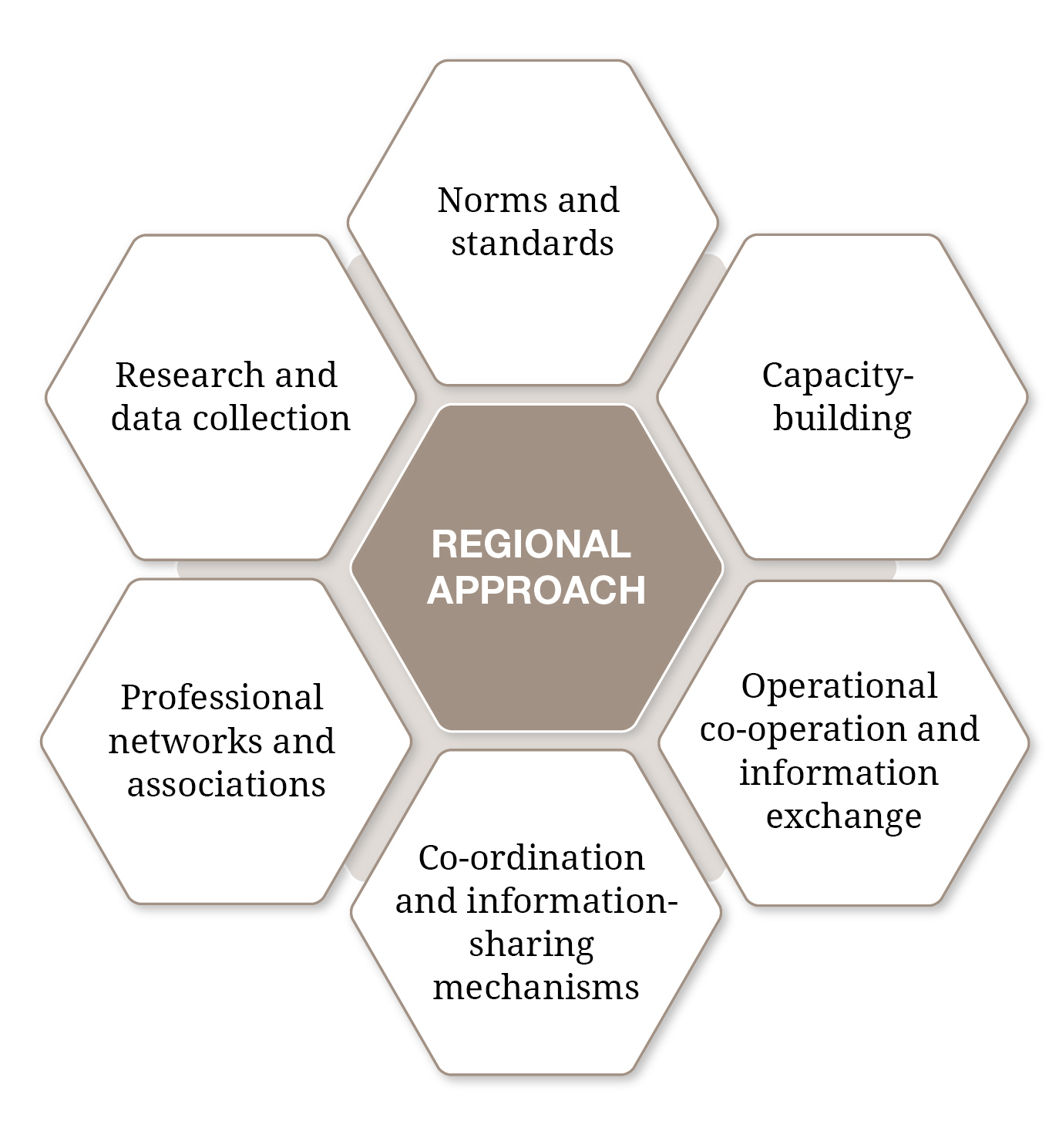
There are different types of programmatic activities that can benefit from a regional approach. When supporting these programmatic activities at the regional level, the following entry points can be considered.
Click on an icon to read more.
 Norms and standards
- Mapping existing international commitments relevant for the security sector that States are yet to ratify or implement in order to identify possibilities for programmatic support;
- Identifying opportunities for developing new international norms and standards for the security sector at the regional level;
- Raising awareness on the importance of adhering to SSG/R-related international norms and standards, and offering support for their national implementation;
- Supporting regional capacity-building initiatives and development of regional strategies and action plans on how to implement SSG/R-related elements in international commitments made by States;
- Organizing regional workshops, seminars and study trips to discuss progress and to exchange experiences in implementation of relevant commitments.
 Capacity-building
- Identifying challenges which are shared by participating States in a given region, and determining whether the States could benefit from regional capacity-building;
- Supporting capacity-building through regional training, simulation exercises, workshops and “peer-to-peer” seminars;
- Considering how capacity-building support delivered at the regional level can be tailored to different national contexts and needs;
- Incorporating sharing of national experiences, good practices and lessons learned as part of a regional capacity-building and allowing enough time to exchange and discuss these in smaller formats (e.g., working groups);
- Ensuring that, where appropriate, a broad range of state and non-state actors, including from civil society and the private sector, are invited to participate in regional capacity-building events to promote confidence building and facilitate co-operation among all relevant stakeholders.
 Operational co-operation and info exchange
- Identifying security challenges that require operational co-operation and information exchange at the regional level;
- Facilitating networking between the security sector institutions of neighbouring States through joint activities (e.g., through joint events such as conferences, workshops, seminars or simulation exercises);
- Promoting the benefits of regional operational co-operation and information exchange (e.g., through sharing of best practices on study visits);
- Supporting the harmonization of standards and practices at the regional level (e.g., through development of a regional manual);
- Supporting the development of regional strategies and action plans to address common challenges;
- Organizing study visits of security sector representatives to other States of the region, which have undergone similar reforms;
- Facilitating participation of security sector officials in relevant regional events, which are likely to promote confidence building or to raise awareness about SSG/R.
 Co-ordination and information-sharing
- Mapping existing regional co-ordination and information-sharing mechanisms in the field of security sector and identifying opportunities for engagement with them. This can be included in a broader SSG/R needs assessment;
- Raising awareness among national security sector institutions and professionals about existing regional co-ordination and information-sharing mechanisms, including at relevant national and regional events;
- Providing support to relevant co-ordination and information-sharing mechanisms through technical support and capacity-building;
- Supporting the establishment of new regional co-ordination and information-sharing mechanisms between security sector institutions to respond to new emerging needs if there is serious interest and commitment on behalf of the States concerned.
 Networks and associations
- Mapping existing regional professional networks and associations in the field of security sector and identifying opportunities for engagement with them (this can be done through an actor mapping exercise, ideally integrated in a broader SSG/R needs assessment);
- Raising awareness among national security sector institutions and professionals about relevant regional professional networks and associations that they may wish to join;
- Providing support to regional professional networks and associations for security sector in the form of technical assistance and capacity-building;
- Involving regional professional networks and associations when implementing SSG/R programmatic activities, including as in-kind contributors or implementing partners;
- Supporting the establishment of new regional professional networks and associations for security sector actors.
 Research and data collection
- Identifying common governance- and reform-related topics and issues that are addressed by security sector institutions from several OSCE participating States and may benefit from comparative research;
- Designing research in a way that its findings and conclusions can serve as a basis for future SSG/R programmatic support, be it at national or regional level;
- Engaging national security-sector actors, including those for management, internal and external oversight, and relevant professional networks and associations (both national and regional) when planning, designing and conducting research;
- Presenting and disseminating findings and outcomes from research to security sector institutions from the States concerned at relevant national and international events.
For further information and specific examples from OSCE practice on each entry point, see section 2 in chapter 3 of the guidelines.