Strengthening Regional Co-operation on SGG/R
| Site: | OSCE eLearning |
| Course: | OSCE Training on Security Sector Governance and Reform (SSG/R) |
| Book: | Strengthening Regional Co-operation on SGG/R |
| Printed by: | Guest user |
| Date: | Thursday, 1 October 2026, 1:25 AM |
Table of contents
- 1. Introduction
- 2. Strengthening Regional Co-operation on SSG/R
- 3. Rationale for a regional approach to SSG/R
- 4. Entry Points for Strengthening Regional Co-operation on SSG/R
- 5. Applying Regional Approaches to SSG/R – 1
- 6. Applying Regional Approaches to SSG/R – 2
- 7. Applying Regional Approaches to SSG/R – 3
- 8. Applying Regional Approaches to SSG/R – 4
- 9. Applying Regional Approaches to SSG/R – 5
- 10. Applying Regional Approaches to SSG/R – 6
- 11. Wrap-up Questions
1. Introduction
Welcome to the third module of the OSCE Training on Security Sector Governance and Reform (SSG/R).
After completing both e-learning and in-class parts of this module, you should be able to:
- Explain benefits as well as challenges of regional co-operation in relation to SSG/R
- Identify entry points to strengthening regional co-operation on SSG/R
- Describe practical steps that can be taken to strengthen regional co-operation in planning and implementing OSCE’s SSG/R-related activities
The module is based on the third chapter of the Guidelines on SSG/R for OSCE Staff (2nd edition), which is required reading for this course.
2. Strengthening Regional Co-operation on SSG/R
3. Rationale for a regional approach to SSG/R
Several OSCE commitments, particularly in the area of transnational threats, recognize the importance of strengthening regional security co-operation. The mandates of certain OSCE field operations also highlight the need to support regional initiatives. Although each security sector is country-specific and SSG/R is primarily a national process, there are several reasons why a regional approach to SSG/R support may be beneficial:
- Regional approaches may provide entry points for SSG/R support at the national level: Some SSG/R issues may be perceived as too sensitive to be discussed at the national level (e.g., sexual harassment or corruption in the security sector). Discussions at the regional level can de-sensitize and raise awareness on such issues, bringing a new dynamic into reform processes and opening doors for further progress. Moreover, supporting the development or implementation of regional commitments may make it easier to advocate for certain issues to be addressed at the national level. Providing a regional platform also makes it possible to bring together a variety of actors who may not be able or willing to meet at the national level. This can contribute to confidence-building among different stakeholder groups.
- Regional approaches are necessary for addressing transnational challenges: Many of today’s security threats and risks (e.g., organized crime, trafficking in human beings, terrorism, cybercrime) are of a transnational nature. Addressing them effectively, therefore, requires regional co-operation, as recognized in several OSCE commitments. Supporting regional exchanges among national security sector institutions is also important in order to promote confidence-building as a prerequisite for collaboration on addressing transnational challenges.
- Regional approaches facilitate exchanges of good practices and lessons learned from reform processes: SSG/R processes can be challenging in any country. Participating States can therefore greatly benefit from sharing experiences – whether positive or negative – from the implementation of reforms in their security sectors. Regional events and activities can facilitate the identification and sharing of such experiences. For example, the OSCE assists participating States in initiating or strengthening national action plans developed in the context of UN Security Council resolutions 1325 and 1540. Regional exchanges on good practices and lessons learned from the implementation of such plans can contribute to strengthening commitment in some countries and can support ongoing reform efforts at the national level.
- Regional approaches can strengthen the contribution of SSG/R to wider conflict prevention: Supporting SSG/R initiatives at the regional level can provide a platform for facilitating dialogue and transnational co-operation. This can in turn contribute to confidence-building and to broader conflict prevention among States.
4. Entry Points for Strengthening Regional Co-operation on SSG/R
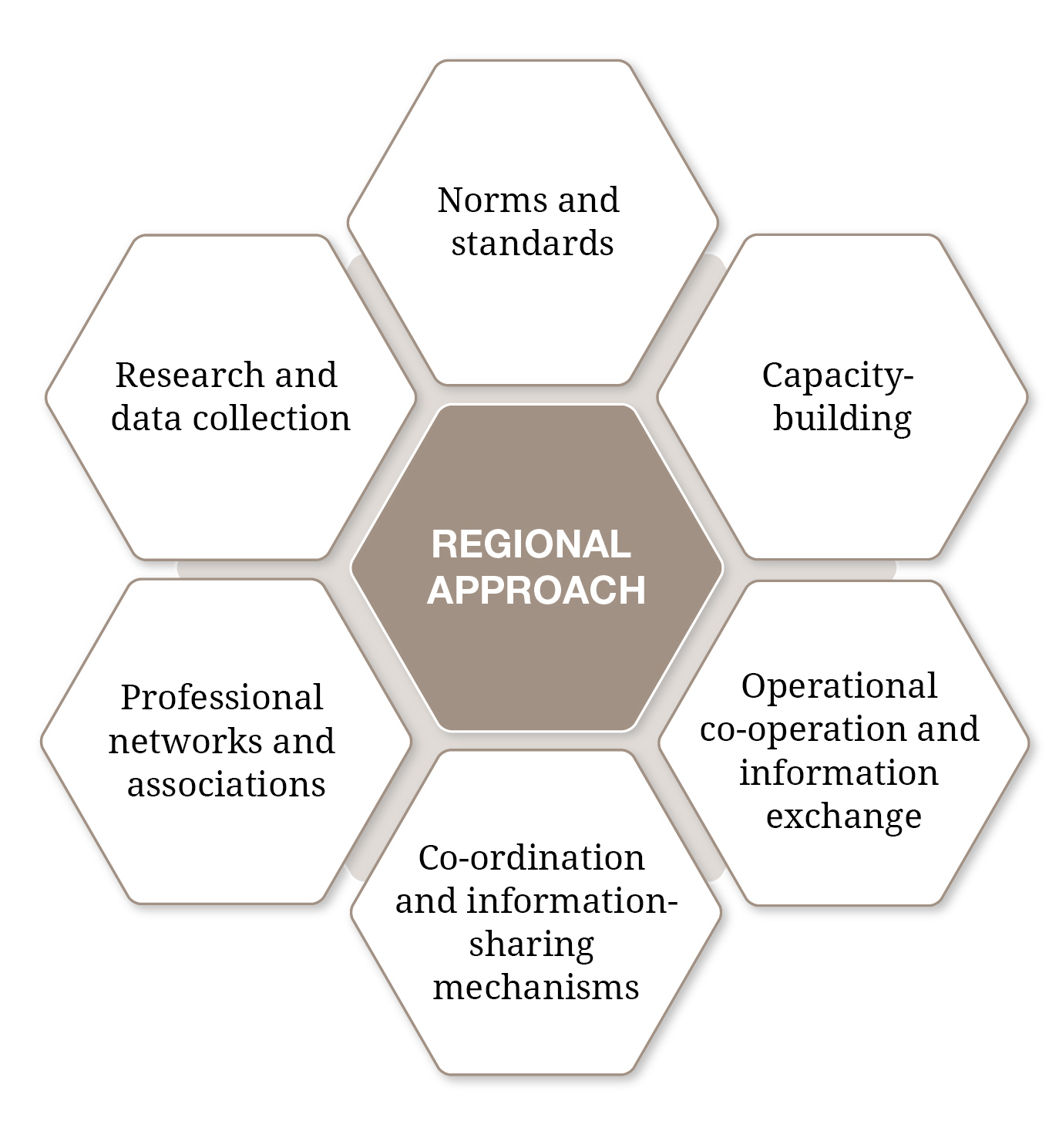
There are different types of programmatic activities that can benefit from a regional approach. When supporting these programmatic activities at the regional level, the following entry points can be considered.
Click on an icon to read more.
 Norms and standards
- Mapping existing international commitments relevant for the security sector that States are yet to ratify or implement in order to identify possibilities for programmatic support;
- Identifying opportunities for developing new international norms and standards for the security sector at the regional level;
- Raising awareness on the importance of adhering to SSG/R-related international norms and standards, and offering support for their national implementation;
- Supporting regional capacity-building initiatives and development of regional strategies and action plans on how to implement SSG/R-related elements in international commitments made by States;
- Organizing regional workshops, seminars and study trips to discuss progress and to exchange experiences in implementation of relevant commitments.
 Capacity-building
- Identifying challenges which are shared by participating States in a given region, and determining whether the States could benefit from regional capacity-building;
- Supporting capacity-building through regional training, simulation exercises, workshops and “peer-to-peer” seminars;
- Considering how capacity-building support delivered at the regional level can be tailored to different national contexts and needs;
- Incorporating sharing of national experiences, good practices and lessons learned as part of a regional capacity-building and allowing enough time to exchange and discuss these in smaller formats (e.g., working groups);
- Ensuring that, where appropriate, a broad range of state and non-state actors, including from civil society and the private sector, are invited to participate in regional capacity-building events to promote confidence building and facilitate co-operation among all relevant stakeholders.
 Operational co-operation and info exchange
- Identifying security challenges that require operational co-operation and information exchange at the regional level;
- Facilitating networking between the security sector institutions of neighbouring States through joint activities (e.g., through joint events such as conferences, workshops, seminars or simulation exercises);
- Promoting the benefits of regional operational co-operation and information exchange (e.g., through sharing of best practices on study visits);
- Supporting the harmonization of standards and practices at the regional level (e.g., through development of a regional manual);
- Supporting the development of regional strategies and action plans to address common challenges;
- Organizing study visits of security sector representatives to other States of the region, which have undergone similar reforms;
- Facilitating participation of security sector officials in relevant regional events, which are likely to promote confidence building or to raise awareness about SSG/R.
 Co-ordination and information-sharing
- Mapping existing regional co-ordination and information-sharing mechanisms in the field of security sector and identifying opportunities for engagement with them. This can be included in a broader SSG/R needs assessment;
- Raising awareness among national security sector institutions and professionals about existing regional co-ordination and information-sharing mechanisms, including at relevant national and regional events;
- Providing support to relevant co-ordination and information-sharing mechanisms through technical support and capacity-building;
- Supporting the establishment of new regional co-ordination and information-sharing mechanisms between security sector institutions to respond to new emerging needs if there is serious interest and commitment on behalf of the States concerned.
 Networks and associations
- Mapping existing regional professional networks and associations in the field of security sector and identifying opportunities for engagement with them (this can be done through an actor mapping exercise, ideally integrated in a broader SSG/R needs assessment);
- Raising awareness among national security sector institutions and professionals about relevant regional professional networks and associations that they may wish to join;
- Providing support to regional professional networks and associations for security sector in the form of technical assistance and capacity-building;
- Involving regional professional networks and associations when implementing SSG/R programmatic activities, including as in-kind contributors or implementing partners;
- Supporting the establishment of new regional professional networks and associations for security sector actors.
 Research and data collection
- Identifying common governance- and reform-related topics and issues that are addressed by security sector institutions from several OSCE participating States and may benefit from comparative research;
- Designing research in a way that its findings and conclusions can serve as a basis for future SSG/R programmatic support, be it at national or regional level;
- Engaging national security-sector actors, including those for management, internal and external oversight, and relevant professional networks and associations (both national and regional) when planning, designing and conducting research;
- Presenting and disseminating findings and outcomes from research to security sector institutions from the States concerned at relevant national and international events.
For further information and specific examples from OSCE practice on each entry point, see section 2 in chapter 3 of the guidelines.
5. Applying Regional Approaches to SSG/R – 1
Ensuring That Regional Co-operation on SSG/R Takes Place within a Broader Framework of Support
Support for regional co-operation on SSG/R needs to take place within a framework of broader support for security sector governance and reform in a given State. Strengthening regional co-operation on SSG/R should therefore not be pursued in the form of ad hoc activities. It needs to be clearly linked to national priorities on SSG/R and the overarching objectives of SSG/R support by the OSCE in a given state.
For instance, strengthening regional co-operation on SSG/R may be identified as a priority for OSCE support if a national priority is to enhance the fight against transnational organized crime. Careful consideration is also needed on how to enhance the sustainability of regional support, with particular reflection on building the capacity of national actors to lead such co-operation, ensuring that follow-up to regional initiatives is planned from the outset, and placing such support within a broader framework of SSG/R engagement.
6. Applying Regional Approaches to SSG/R – 2
Including a Regional Dimension in Planning and Implementing SSG/R Activities
OSCE staff engaged in implementing SSG/R activities should ensure that the challenges and opportunities of applying a regional approach are considered already at a planning stage. SSG/R needs assessments should thus include analysis of the regional dimension in order to identify potential benefits and feasibility of a regional approach, which should subsequently inform project development and design. Among other things, this involves understanding the regional political dynamics and assessing common SSG/R-related challenges in a given region. Assessments should also consider existing regional initiatives and commitments, which may provide entry points for SSG/R activities at the national level and map existing regional bodies that work with security sector institutions. Finally, assessments should also take into account lessons learned from the experiences of other States in the region in implementing similar reforms.
In considering opportunities and challenges for applying a regional approach to SSG/R activities during the planning phase, OSCE staff should take advantage of the experiences and knowledge of their colleagues from other OSCE Executive Structures, especially those operating in a given region. Regular planning and co-ordination meetings between different Executive Structures as well as various focal points networks can be used for this purpose. Different focal point networks across executive structures offer an opportunity to share experiences and knowledge resources with neighbouring field operations. In less formal settings, ad hoc consultations with colleagues working on the same thematic issues in neighbouring countries can provide invaluable input to planning and designing SSG/R activities.
These colleagues can be instrumental also during the implementation phase. They can share experiences, good practices and lessons learned from their SSG/R programmatic activities. Consultations with colleagues can also help identify opportunities for pooling resources or developing new joint regional initiatives across different OSCE Executive Structures.
7. Applying Regional Approaches to SSG/R – 3
Promoting the Understanding that Regional Co-operation on SSG/R Can Be Cost-Effective
Investing in enhancing regional co-operation on SSG/R between participating States may have a long-term impact that will offset potential initial costs in terms of resources or time necessary to build mutual trust. It is important to recognize that regional co-operation on SSG/R can be cost-effective despite a certain initial investment required at the beginning. It can therefore be beneficial for the OSCE to work with existing structures and mechanisms facilitating regional co-operation in order to strengthen their capacities and thus increase the long-term sustainability of support for reform efforts in the region. Moreover, in some cases, there may be cost benefits if expenses or resources for implementing SSG/R activities are pooled. Finally, the OSCE should raise awareness of the fact that, from a national perspective, it may be often more cost-effective to tackle common challenges, such as transnational organized crime or trafficking in human beings through regional co-operation.
8. Applying Regional Approaches to SSG/R – 4
Capitalizing on Existing Regional Knowledge Resources, Co-ordination and Information-Sharing Mechanisms
For supporting regional initiatives and ensuring co-operation across OSCE Executive Structures engaged in a given region, capitalizing on existing knowledge resources and information-sharing mechanisms can be useful in order to identify opportunities, common challenges, best practices and lessons learned. Online information-sharing tools can also provide an important platform for enhancing regional co-operation and collaboration among OSCE staff, as well as serving as useful resources for security sector professionals and civil society.
For examples of such tools, see infobox 2 in chapter 3 of the guidelines.
9. Applying Regional Approaches to SSG/R – 5
Following a Step-By-Step Approach
National ownership is a key prerequisite for the OSCE’s support to SSG/R. If the will necessary to engage in regional initiatives is lacking in a given State, the OSCE should recognize it. In order to support the development of interest in regional initiatives, taking an incremental, step-by-step approach could still be considered. Such an approach could, for example, initially only aim to support regional co-operation on a technical level by, for instance, supporting the participation of national experts in regional training courses. This may contribute to both building confidence between participating States and highlighting the benefits of a regional approach, thus paving the way for a more comprehensive form of regional co-operation in the future.
10. Applying Regional Approaches to SSG/R – 6
Recognizing that Regional Approaches Have Their Limitations
Although States in a given region may share similar challenges, specific national requirements must not be overlooked. Regional priorities should thus always be carefully examined against national priorities to ensure that there is complementarity and, hence, a rationale for the OSCE to support them within a given State.
In some circumstances, regional approaches may also not be beneficial: for example, when States are at different stages of implementation of a certain reform process or when a participating State does not share (or does not perceive itself as sharing) similar challenges with neighbouring States. Moreover, sometimes the mandates of OSCE field operations in a given region vary too much to allow for a coherent regional approach. Certain field operations do not have mandates for regional programmatic activities and require assistance from one of the OSCE institutions or the OSCE Secretariat if they are to give effective support to such initiatives. Appropriate assessments, including timely communication with host authorities, and exploring of possibilities with other OSCE Executive Structures, are thus essential to ensure that the benefits and challenges of a regional approach are well understood.