Completion requirements
2. Working definition of SSG/R in the OSCE context
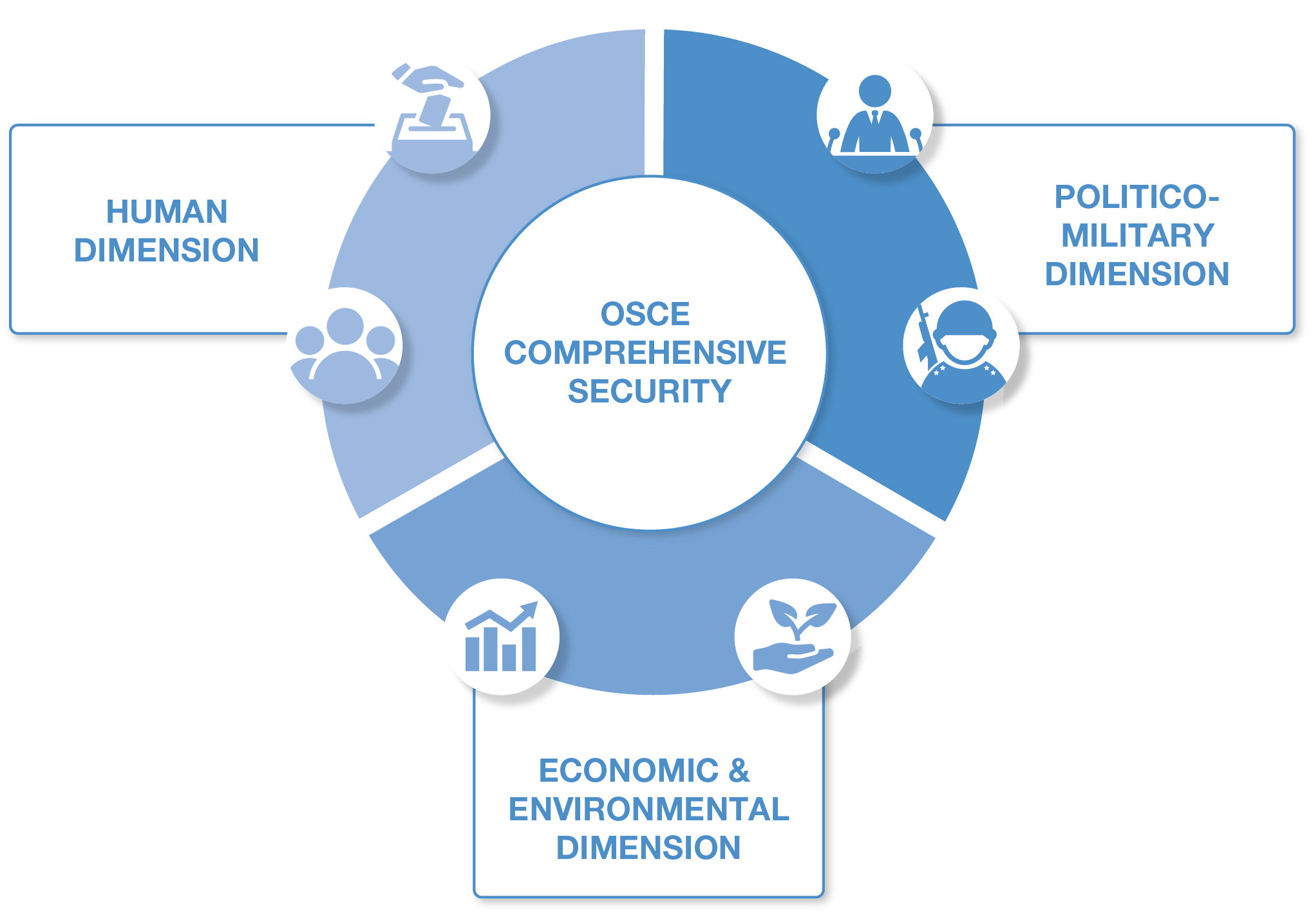
Changes in the international security environment since the end of the Cold War and in the nature of conflicts, from predominantly inter-state to intra-state or hybrid conflicts, have created a paradigm shift in the understanding of security. The conventional state-centred model that primarily emphasized military aspects of security has been gradually complemented by a new concept that also recognizes non-military aspects of security and applies a people-centred approach, in that it centres on the security needs of all individuals and communities. The 1975 Helsinki Final Act can be seen as a precursor of this shift, as it pioneered a broader understanding of security at both the state and individual level. This broad understanding later evolved into the OSCE’s comprehensive concept of security with its three dimensions: the politico-military, the economic and environmental, and the human dimension.
Security began to be seen as a matter of concern for all institutions – from legislative bodies and justice systems to all citizens, both as individuals and as members of civil society. It also began to be seen as a public good, which should be provided according to the same standards and principles as any other public service. The term “security sector” was coined and with it the concept of “security sector governance” and “security sector reform.”
While there is no formal definition of SSG/R in the OSCE, a working definition has developed over time:
Good security sector governance means that the security sector is subject to the same standards of good governance as any other public sector.
Good governance standards and principles mean that the security sector is to provide security to the State and its people in an accountable and effective way, within a framework of democratic civilian control, rule of law, respect for human rights, and the promotion of gender equality.
Activities aimed at improving security sector governance are defined as security sector reform even if they are not always explicitly referred to as such.
Accordingly, security sector governance and reform is a political and technical process through which a country seeks to enhance the good governance of its security sector.
To better understand this working definition, it is necessary to explore its individual components. These include the security sector, security sector governance and security sector reform. All of these components are underpinned by a people-centred approach to security, complementing the traditional state-centred approach.