Kërkesat e përfundimit
6. Conducting the Needs Assessment: Preparatory Analysis
The preparatory analysis for a needs assessment is conducted through desk research to systematically gather available primary and secondary data. The analysis maps the broad political, economic, security, institutional and legal context in which the security sector operates. It is also used to identify gaps in data and the questions that will need to be answered during the in-country assessment in order to fill those gaps. A comprehensive preparatory analysis thus helps to plan a purposeful in-country assessment and will consequently reduce the amount of resources required.
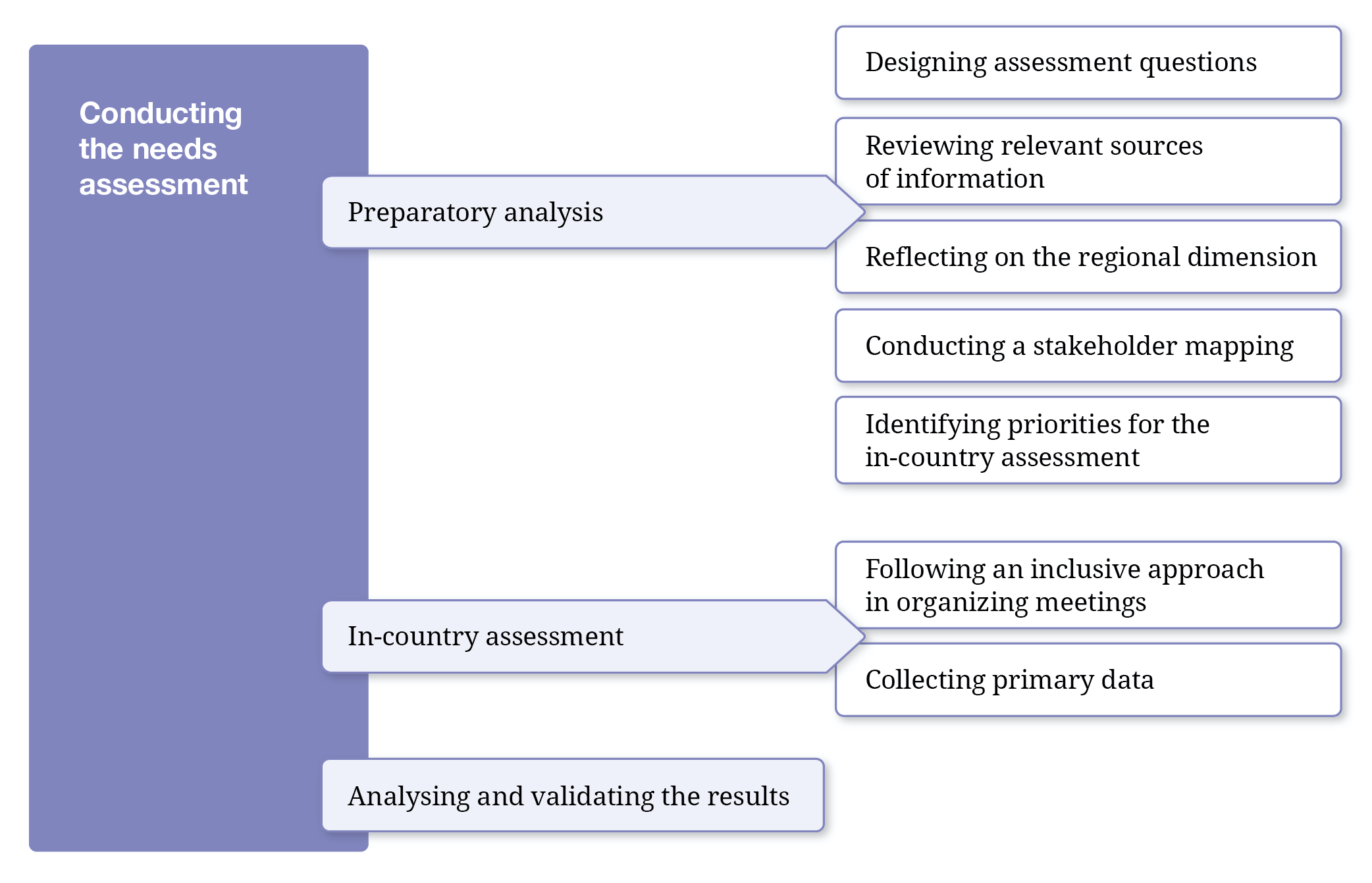
The preparatory analysis consists of several steps that are briefly described below. For additional information, see section 3.1 in Chapter 4 of the Guidelines.
Designing the assessment questions: Based on the guiding questions specified in the ToR, the assessment team will develop more detailed questions to help in collecting and analysing data. These assessment questions should be used during both the desk-research analysis of data and the in-country collection of data. For examples of assessment questions, see Info Box 2 in Chapter 4 of the Guidelines.
Reviewing relevant sources of information: Information from multiple sources and institutions should be reviewed to ensure a broad understanding of the political context, the legal framework, previously identified gaps and challenges, evaluation findings and lessons learned, and the roles and responsibilities of security institutions. Gender-related aspects must also be considered, such as the security risks and needs of women, men, boys and girls and their access to security services, as well as what hinders gender equality in the security sector. A specific gender analysis of the security sector, including on the representation of women in senior positions and their roles in decision-making, can help to identify gender-related gaps and needs. For examples of relevant sources of information, see Info Box 3 in Chapter 4 of the Guidelines.
Reflecting on the regional dimension: During the desk research, appropriate consideration also needs to be given to the regional dimension, as it is an important element of situation analysis. The regional dimension may include regional conflict dynamics, sources of cross-border tensions and regional co-operation dynamics. Regional challenges may require specific actions in SSG/R, such as strengthening international co-operation. Desk research should therefore seek to answer the following questions: Are there ongoing initiatives or existing commitments at the regional or international level that may provide entry points for national reform efforts? Have other states in the region recently undergone similar reform processes from which lessons may be learned? Would a regional approach to SSG/R support be valuable?
Stakeholder mapping and identifying priorities for the in-country assessment: Data collected during the preparatory phase should be analysed to identify priorities for the subsequent in-country assessment. Priorities may be identified on the basis of:
- Gaps in information: The desk-based research may highlight areas where information is lacking. Such areas should be given special attention during the in-country assessment so that interviews can help to complete the picture.
- Potential priorities for reform: Potential gaps and priority needs for SSG/R may be identified during the research. Assumptions about needs should be tested through interviews during the in-country assessment to ensure they hold true.
On the basis of the preliminary gaps and priorities identified during the desk-based preparatory analysis, the key stakeholders can be mapped. Based on the stakeholder mapping, decisions can be taken on specific stakeholders who should be interviewed in order to fill specific gaps, in addition to interviewing a broad representative sample of interlocutors.