Kërkesat e përfundimit
4. Planning for Needs Assessment - 2
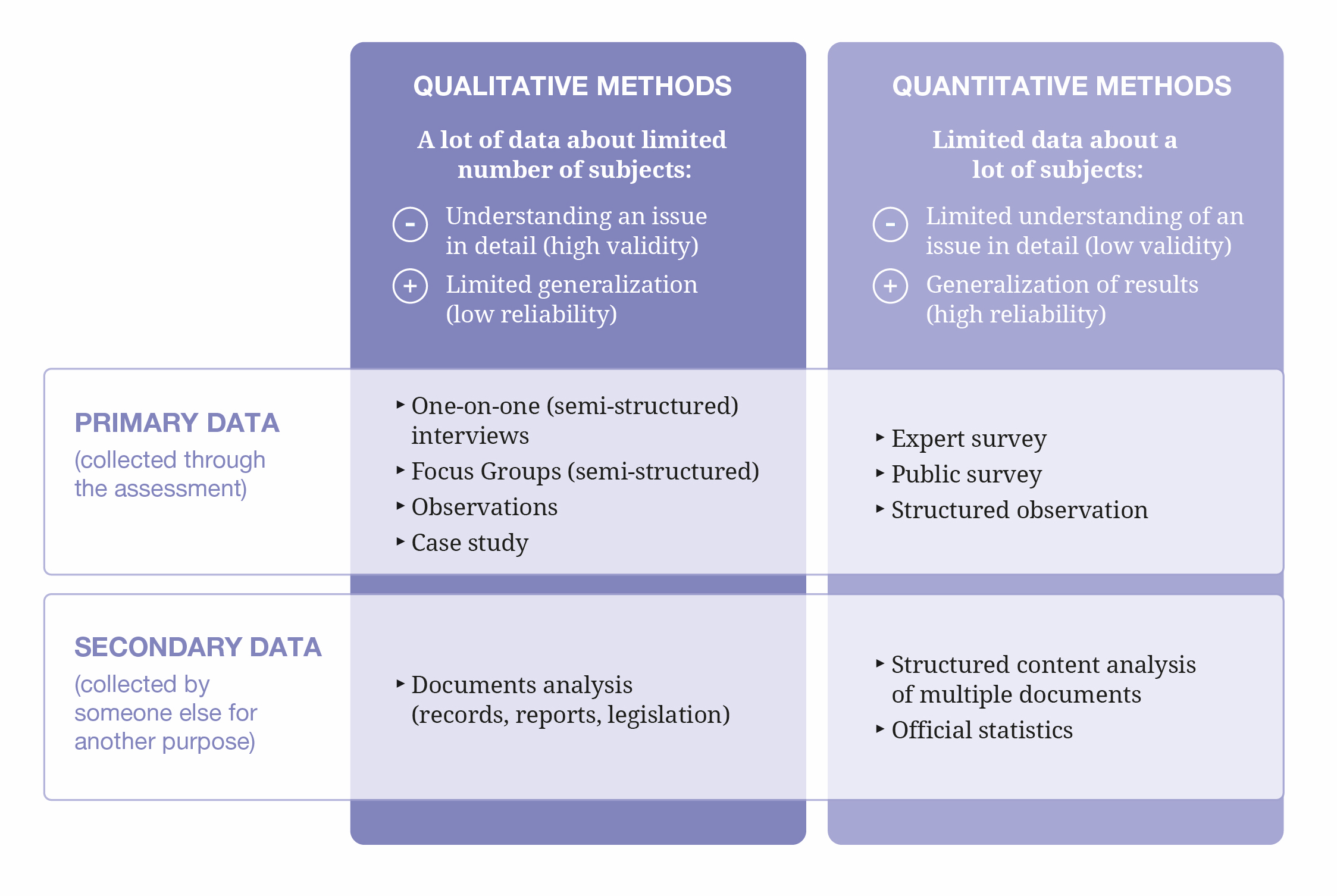
Defining the Methods and Recognizing Challenges in Data Collection: The ToR should set out the initial sources and methods for data collection, ideally consisting of a combination of public and internal data sources, qualitative and quantitative data collection methods and analysis methods relevant to the sector. Data collection, whether desk-based or field research, can be challenging, mainly because of the accessibility and reliability of data. To build trust with respondents, clear assurances are required on how information will be stored and about how the findings of the needs assessment will be disseminated. To increase the reliability and effectiveness of the needs assessment, data sources need to be triangulated through both quantitative and qualitative data collection methods.
Setting Benchmarks and Developing Guiding Questions: Benchmarks can be used to identify the priorities to be examined during a needs assessment. While there is no consistent set of internationally recognized benchmarks for SSG/R, there is general agreement that the security sector should be both effective and accountable. Therefore, some of the key SSG/R benchmarks are related to effectiveness (e.g., adequate service delivery) and accountability (e.g., internal accountability and external oversight, respect for human rights and gender equality, etc.). In some areas of SSG/R, specific international standards may exist that can be used to set benchmarks. To complement the benchmarks set and to specify in greater detail the issues that the assessment will focus on, the ToR should always include (preliminary) guiding questions for the assessment. The guiding questions need to be derived from the assessment’s scope. They can be formulated generically but should be specific enough to articulate what should be examined.
Establishing Roles and Responsibilities: Clear roles and responsibilities need to be assigned, not only when the needs assessment is jointly conducted with other international actors or beneficiary driven but also when the OSCE is in the lead. Roles and responsibilities should be assigned in four areas: (1) leading the assessment, (2) contributing to the assessment (human and financial resources), (3) collecting data and analysing it and (4) disseminating the results of the assessment.