Cross-Dimensional Approaches to SSG/R
| Site: | OSCE eLearning |
| Course: | OSCE Training on Security Sector Governance and Reform (SSG/R) |
| Book: | Cross-Dimensional Approaches to SSG/R |
| Printed by: | Guest user |
| Date: | Thursday, 1 October 2026, 1:25 AM |
Table of contents
- 1. Introduction
- 2. Cross-Dimensional Approaches to SSG/R
- 3. Rationale: Addressing Security Comprehensively and Cross Dimensionally
- 4. Rationale: Providing Effective Programmatic Support to Advance Good Governance in the Security Sector
- 5. Identifying Cross-Dimensional Synergies
- 6. Practically Applying a Cross-Dimensional Approach to SSG/R Programming
- 7. Wrap-up Questions
1. Introduction
Welcome to the second module of the OSCE Training on Security Sector Governance and Reform (SSG/R). After completing both e-learning and in-class parts of this module, you should be able to:
- Explain how the concept of SSG/R is applicable to the OSCE comprehensive concept of security and its different dimensions
- Identify entry points for strengthening cross-dimensional co-operation in different types of OSCE programmatic support to SSG/R
- Describe practical steps that can be taken to strengthen cross-dimensionality in planning and implementing OSCE’s SSG/R-related activities
The module is based on the second chapter of the Guidelines on SSG/R for OSCE Staff (2nd edition), which is required reading for this course.
2. Cross-Dimensional Approaches to SSG/R
3. Rationale: Addressing Security Comprehensively and Cross Dimensionally
The OSCE’s work as a regional organization is founded on a broad understanding of security. Already in the 1975 Helsinki Final Act, participating States acknowledged the importance of addressing security holistically, through three indivisible dimensions: the politico-military (first) dimension, the economic and environmental (second) dimension, and the human (third) dimension.
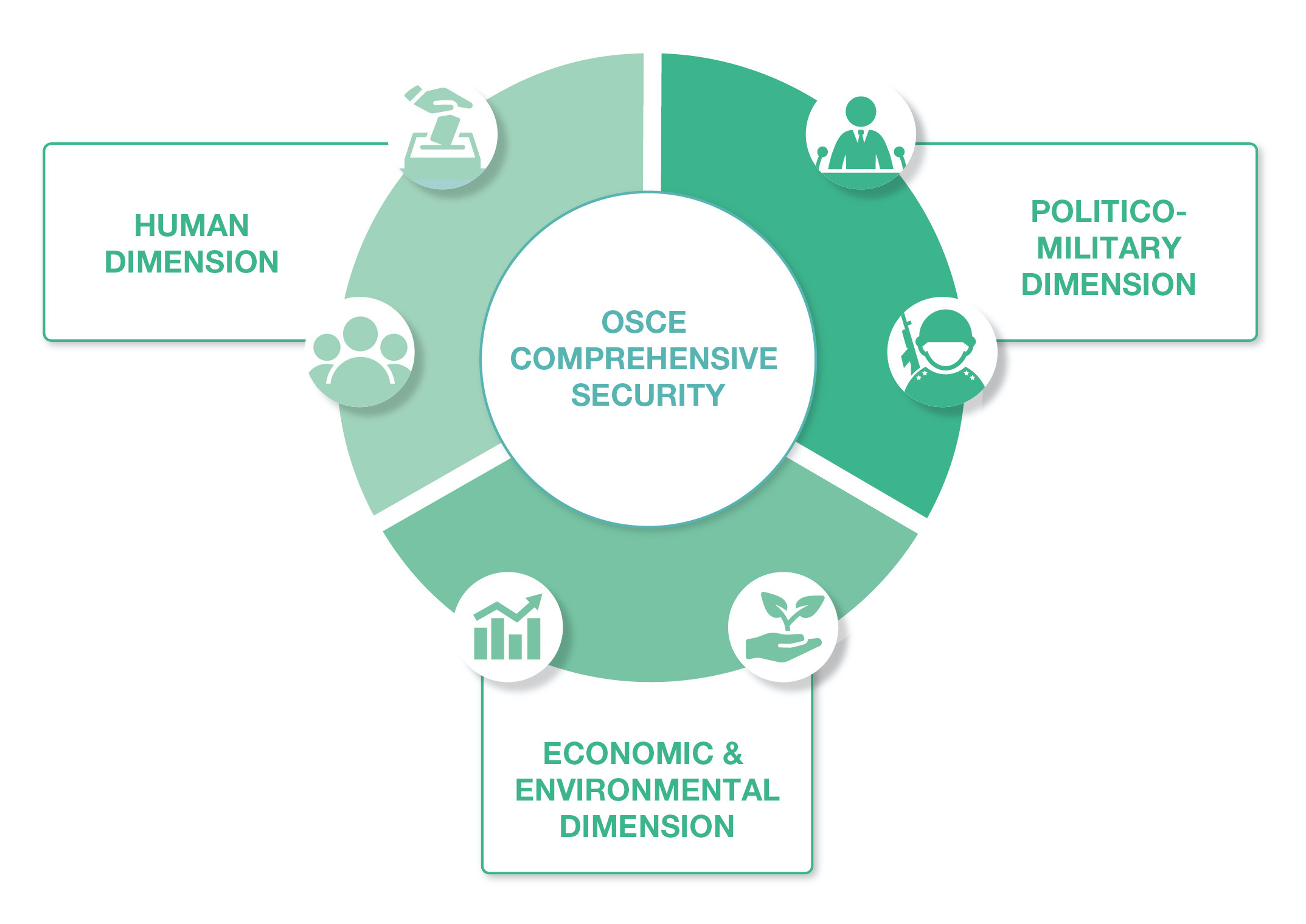
Security was no longer seen narrowly as the result of preventing conflicts between states or through the use of advanced intelligence and defence systems, but rather as a matter of concern of all institutions – from legislative bodies to the justice systems – and of all citizens, individually and as members of civil society. In this respect, the OSCE’s approach to security is in itself cross-dimensional.
To effectively support participating States in ensuring good governance of the security sector, Executive Structures and its departments and units in all three dimensions need to contribute and have the expertise to do so. The need for a cross-dimensional approach is acknowledged in numerous OSCE commitments, which are of direct relevance to SSG/R and highlight its importance.
Several Ministerial Council decisions recognize that gender equality, human rights protection and non-discrimination all require mainstreaming across all three dimensions, which naturally involves judicial, prosecutorial and law enforcement actors within the security sector. A cross-dimensional approach therefore integrates the work of the various actors and components of the security sector across all three dimensions, thereby implementing the OSCE comprehensive concept of security.
4. Rationale: Providing Effective Programmatic Support to Advance Good Governance in the Security Sector
For the OSCE to implement a cross-dimensional approach in the field of SSG/R and to effectively support national reform processes in a comprehensive manner, joint efforts by actors in all three dimensions are needed and should be pro-actively sought in all related activities, irrespective of whether the activities “institutionally” fall under one dimension or another.
There is a risk that the cross-dimensional approach may be understood in terms of actors from each dimension providing support in their own area of SSG/R without seeking to understand or contribute collectively to a common objective or to build on related synergies. It is thus necessary to move beyond a “one-dimensional” approach to ensure that appropriate links between the dimensions are identified and supported. In a country-specific context, a cross-dimensional approach requires that common goals be set, to which actors in all dimensions contribute in order to maximize the overall impact. Support from senior management to establish strategic frameworks will be necessary to implement such an approach, starting from the programmatic planning stage.
Ultimately, the purpose of supporting cross-dimensional approaches to SSG/R is to enhance the efficiency, effectiveness, transparency and impact of OSCE support. Furthermore, cross-dimensional approaches provide legitimacy to the OSCE when raising awareness among national actors about the need to adopt a comprehensive national approach to SSG/R.
While many OSCE commitments call for a cross-dimensional approach, cross-dimensionality may not always be achieved in practice. Many SSG/R activities might be treated under the first dimension, thereby neglecting pertinent contributions from the other two dimensions.
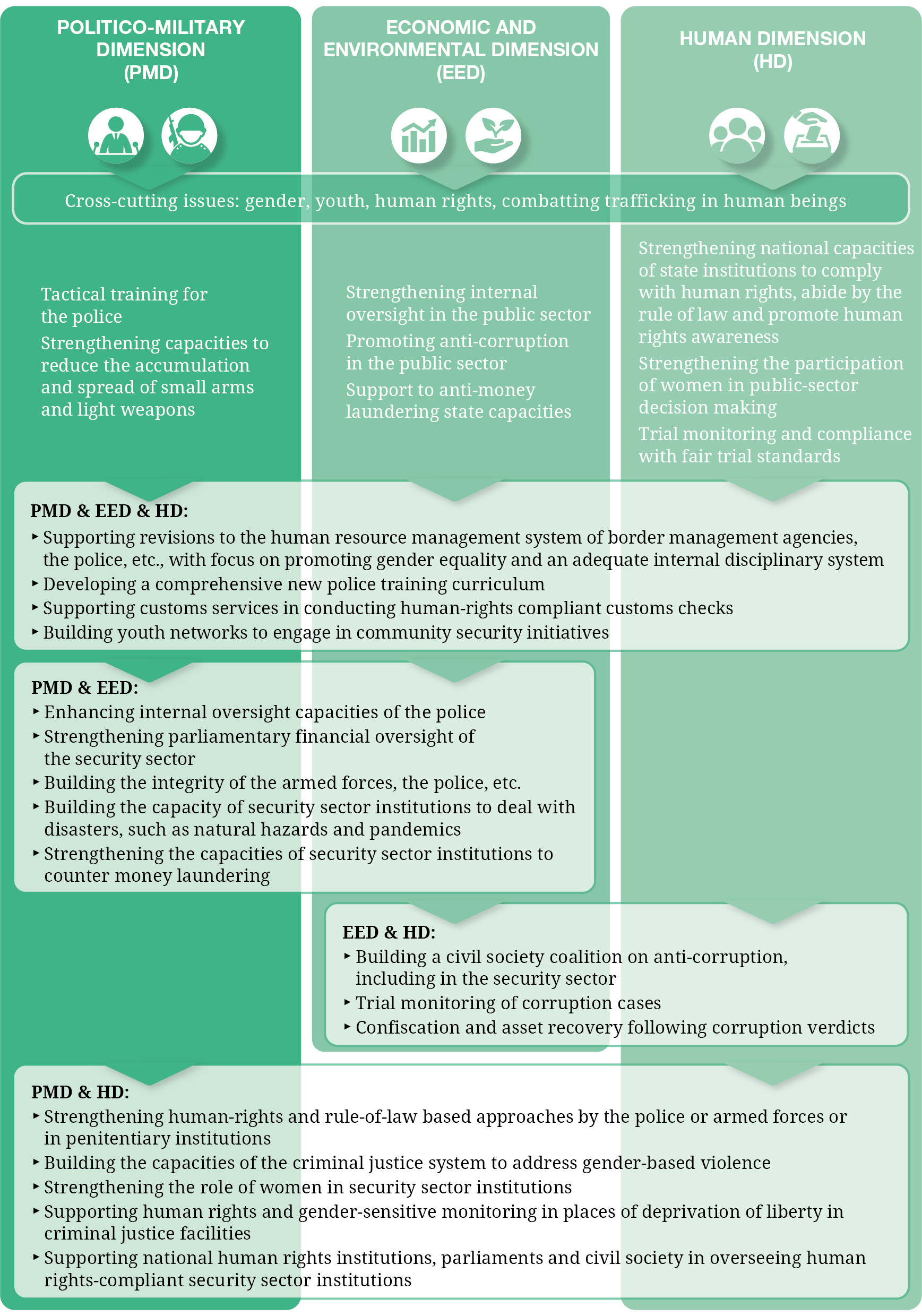
Additionally, some activities are not always institutionally led by one dimension but cut across several dimensions, known as cross-cutting activities. This is the case, for instance, with OSCE activities to combat human trafficking, to counter terrorism or to promote gender equality and human rights in the security sector, all of which require expertise from all three dimensions. While some of these cross-cutting issues, like gender or human rights, are addressed in first dimension activities, they are at times simply tacked on at the end of a process, rather than being mainstreamed throughout it, starting from the planning stage. Likewise, opportunities to strengthen good governance of the security sector have sometimes also been missed because the issue is seen as only relevant to the second dimension.
5. Identifying Cross-Dimensional Synergies
Promoting effective SSG/R requires contributions from programming in all three dimensions towards a security sector that upholds human rights and the rule of law, ensures gender equality, and adheres to the principles of accountability, transparency, effectiveness, participation, inclusivity and responsiveness.
One of the first steps is to identify the potential synergies to be promoted. While the following list is not exhaustive, it does provide some entry points that can be used in OSCE programmatic support to promote the implementation of good security sector governance principles.
Click on each tab to read more
 Linking Police and Judicial Reform
The importance of supporting linkages between police and judicial reform is recognized in a number of OSCE documents. The success of police reform is highly dependent on parallel progress of the judicial system. Supporting such linkages in a comprehensive manner requires a cross-dimensional approach. For example, enhancing the capacity of the police to make arrests also requires consideration as to whether there are a sufficient number of adequately trained defence lawyers. Furthermore, to ensure effective processing of criminal cases, it is important to support co-ordination between the police and judicial actors. Failure to recognize synergies between police and judicial reform can lead to dysfunctional responses to dealing with crime, resulting in frustration among the population and a lack of trust in these institutions.
 Fostering Democratic Oversight
Like any other public sector, the security sector must be subject to democratic oversight. This principle is a cornerstone of effective SSG and has been affirmed by the OSCE in various documents. Democratic oversight may be carried out by parliaments, the judiciary or independent bodies, such as national human rights institutions. Effective support to oversight, as a means of contributing to good SSG, requires expertise from different dimensions. Common challenges to the OSCE’s support include perceptions that democratic oversight of the security sector is too sensitive in a given context, or a lack of clear institutional lead within the OSCE dimensions and hence a lack of adequate planning to establish the specific roles and responsibilities of OSCE actors.
 Strengthening Integrity and Anti-Corruption
Like in any other public sector, accountability, transparency and effectiveness are essential principles of good security sector governance. Therefore, SSG support also should include efforts to build integrity and counter corruption. Moreover, a number of OSCE commitments call for the effective management of public resources through strong and well-functioning institutions and recognize the role of the security sector in fighting corruption. Good security sector governance requires that national executive structures possess well established, sound and functional internal control mechanisms and management practices, including human, financial and information resource management, as well as procurement regulations. Within the OSCE, programmes in the second dimension often lead efforts to strengthen financial resource management. However, this support often focusses broadly on strengthening budgetary management, with no specific focus on the security sector. As improving internal accountability and management mechanisms is essential to increase the effectiveness of the security sector, joint and complementary contributions from OSCE Executive Structures in the different dimensions could be of benefit to this end.
 Engaging with Civil Society
Civil society can have multiple important roles in SSG/R, specifically in relation to accountability, transparency, human rights, participation, inclusivity and responsiveness, which are important to consider in all OSCE dimensions. For example, in relation to a people-centred approach to security, civil society organizations will usually possess important knowledge on the security needs of women, men, boys and girls and/or knowledge on specific local or regional issues that affect the security sector. As civil society can play an important role in communicating the security needs of the population to policymakers, they should be included in dialogue on reform priorities.
Civil society can also be a key source of information when conducting needs assessments and, thus, can contribute to OSCE programming. They should therefore be consulted in such processes. Civil society can also play an informal oversight role by holding authorities accountable for their actions through lobbying and advocacy campaigns. Academia and think tanks also have a role to play by providing research and analysis that can contribute to advocacy campaigns related to respective reform processes. The media, as a part of civil society, can ensure public access to information and provide a platform to voice concerns. Protecting media freedom is vital in democratic societies, and thus, it has become an integral part of the OSCE’s work – in particular, through the OSCE Representative on Freedom of the Media. Without a comprehensive approach that includes civil society, it is therefore not possible to succeed in addressing essential aspects of SSG/R.
 Mainstreaming and Promoting Gender Equality
Gender equality, women’s rights and women’s empowerment are essential elements of the OSCE’s concept of comprehensive security that are included in a number OSCE Documents. In the field of SSG/R, OSCE commitments set out the need to “create equal opportunities within the security services, including the armed forces, where relevant, to allow for balanced recruitment, retention and promotion of men and women.” The need to promote the engagement of women in judicial, prosecutorial and law enforcement institutions is also recognized, as is the need to promote women in parliamentary oversight of the security sector. The OSCE has also called for efforts to support the police in dealing with sexual and gender-based violence and recognized the important role of women in conflict prevention and peace-building.
To meet these commitments, especially a better understanding is required of gender dynamics in issues addressed by security sector institutions, such as preventing and countering terrorism, or about how exclusion of women in security sector institutions hampers their effective functioning. Integrating gender perspective in every stage of programmatic work and respective project design – including development, implementation and monitoring could help to increase the understanding of prevailing gender dynamics.
 Mainstreaming and Promoting Human Rights
The promotion of human rights is a fundamental OSCE principle. In the context of the security sector, this principle requires both that the security sector respects, protects and fulfils human rights and that the human rights of security sector personnel are respected. Cross-dimensional approaches to SSG/R require that the promotion of respect and the protection and fulfilment of human rights be mainstreamed into OSCE activities with the security sector. Doing so may involve preventive measures, such as support on legislation, preventive visits to places of deprivation of liberty or capacity-building for security sector institutions or oversight bodies. Mainstreaming human rights may also include reactive measures, such as advocacy for the investigation of torture allegations.
 Taking Advantage of Synergies: A Cross-Dimensional Approach to SSG/R Support
Linking police and judicial reform, fostering independent oversight, strengthening integrity and anti-corruption and engaging with civil society, as well as mainstreaming and promoting gender equality and human rights, are all areas of support that, in practice, are mutually complementary and can often not be clearly delineated from each other. For example, when strengthening gender equality and accountability of the security sector, civil society can play an important role in providing external oversight. Also, the external oversight role of civil society can make an important contribution to both police and justice sector reform.
6. Practically Applying a Cross-Dimensional Approach to SSG/R Programming
When planning SSG/R support, cross-dimensional issues are often rarely considered in full. The reasons for this could include a lack of strategic approach, cross-dimensional expertise, co ordination or resources, bureaucratic hurdles or, simply, competition. To overcome such challenges, incentive structures should be developed that encourage cross-dimensional co ordination from the start of programmatic planning. Some steps to put incentive structures in place are outlined in this section. For all of them, the support of senior management is essential to ensure that cross-dimensional approaches to SSG/R are recognized and encouraged as a core element of OSCE support.
Ideally, senior management and supervisors could also consider using the staff performance-evaluation process to encourage cross-dimensional co-operation, both for staff with programming and administrative roles.
Click on each headline to read more.
A cross-dimensional approach to SSG/R support requires a strategic vision of the support to be provided by the OSCE (and other international actors) in a given context. The development of a strategic vision for support should ideally be based on a needs assessment that determines the national needs and priorities for SSG/R support. The strategic vision should consist of specific goals, to which programmes in all OSCE dimensions will jointly contribute. In OSCE field operations, the Head of Mission, senior management as well as the policy and planning and/or programme co-ordination and support units will play an important role in encouraging a cross-dimensional approach to SSG/R.
A key challenge in SSG/R processes is to ensure a holistic approach to reform that takes into account linkages between the various actors and components of the security sector. Such an approach recognizes that reforms in one part of the security sector may not be successful if their effects on the rest of the security sector are not properly considered. Thus, OSCE efforts to ensure a cross-dimensional approach to SSG/R provide an opportunity to engage national stakeholders on the importance of holistic reforms. Co-operating with multiple actors in the security sector is therefore key, but in itself does not ensure that the approach is cross-dimensional. The OSCE might be better placed to provide credible advice in this area if it is also seen as promoting a comprehensive, cross-dimensional approach internally. OSCE staff should therefore communicate with national stakeholders about the OSCE’s own internal cross-dimensional approach to SSG/R support. Doing so can provide entry points to raise awareness among national actors on the importance of a comprehensive approach to SSG/R.
Roles and responsibilities tend to become blurred when several executive structures and/or departments within them are working on a topic that cuts across all dimensions, but the lead actor is not clearly defined. Once SSG/R priorities have been identified, the executive structure/department that will lead the provision of support should be clearly identified. The lead actor should then determine how support can be provided by other unit/departments in other dimensions in a complementary manner, including in the allocation of budget. This is particularly important to avoid gaps in priority areas, owing to a lack of clarity about which project or programme in the three dimensions should be taking the lead. Defining roles and responsibilities from the start of programmatic planning is also closely linked with internal co ordination in the subsequent implementation phase. Senior management plays an important role in encouraging such cross-dimensional co-operation and in setting up incentive structures for this purpose.
Once strategic priorities and common goals have been set and the roles and responsibilities clarified, these should be considered and reflected accordingly when drafting project proposals. The process of drafting project proposals can also be used to actively promote cross-dimensionality for SSG/R support. Some field operations have updated their UB project proposal templates for this purpose. In some field operations, project co-ordination units have been established in the Office of the Head of Mission to encourage cross-departmental consultations on all project planning. Such units can play an important role in encouraging a cross-dimensional approach to SSG/R support. Efforts should also be made at the departmental level to identify the extent to which cross-dimensional SSG/R linkages have been appropriately considered when developing relevant projects. Once roles and responsibilities are clarified on who is to lead the project and how responsibilities regarding implementation are distributed, these roles and responsibilities will also need to be reflected in the project-set up. A cross-dimensional project set-up can take different forms, also depending on whether funds are UB or ExB.
Establishing or making full use of internal co-ordination mechanisms is key to supporting cross-dimensional approaches. One such mechanism includes regular exchanges between heads of programmes or relevant project managers. Others include the development of matrices on common priorities or exchanges of information on the issues in the different dimensions that are regularly addressed with national stakeholders. Senior management has a key role to play in promoting internal co-ordination.
SSG/R focal points also have a crucial role to play in co-ordinating cross-dimensional SSG/R issues. Focal points in related areas can also contribute to mainstreaming SSG/R in their areas of work. For example, gender focal points in executive structures promote gender mainstreaming throughout the OSCE’s work, including in the area of SSG/R. Similarly, focal points on combatting human trafficking or on Roma and Sinti can all create synergies between their work and SSG/R efforts. That being said, focal points require adequate time and resources to be successful in co-ordinating efforts, as focal point roles are fulfilled in addition to the regular tasks and duties of OSCE officials. Also of importance is that the co ordination efforts of focal points be made in a way that fully respects the mandates of their executive structures.
For further information and concrete examples, see section 3 in Chapter 2 of the Guidelines.